February 2, 2017

Mamemaki: Demons Out! Luck in!


Setsubun (節分) celebrated yearly on February 3 in Japan is accompanied by a special custom called mamemaki (豆まき), literally means “bean scattering”. This is to drive away evils who bring misfortune and bad health for the coming year and welcome fortune into the household.  Setsubun, "division of seasons", used to mark the end of winter and summer, means the day before the first day of spring (立春risshun)

Roasted soybeans called the "fortune beans" (福豆fukumame,) are thrown either out the window or at a member of the family wearing an oni or an ogre mask, while the people shout  "Demons out! Luck in!" (鬼は外! 福は内!, Oni wa soto! Fuku wa uchi!?) and then eat the soybeans, one for each year of one’s life to bring good luck and prevent sickness for the year to come. While this is still a common practice in households, many people also attend a shrine or temple's spring festival where this is done.

In popular temples like Senso-ji in Asakusa, Tokyo or the Naritasan Shinshou-ji, Chiba, where they receive wide media coverage, celebrities, sumo wrestlers or kabuki actors are invited and they throw roasted soy beans, small envelopes with money, sweets, candies and other prizes. Crowds of nearly 100,000 people who attend the annual festival turn wild with everyone pushing and shoving to get the gifts tossed from above.

Another practice like in the Kansai area or Osaka, it is customary for families to eat uncut makizushi called eho-maki (恵方巻, lucky direction roll) while facing the direction considered to be auspicious usually determined by the zodizc symbol of that year. Eho-maki can also be purchased at stores in the Kanto area and it is getting more recognized as a part of Setsubun tradition. In some families living near the coastal area, it's common to put up small decorations of sardine and holly leaves (柊鰯 hiragi iwashi) on their house entrances so that bad spirits will not enter. Other practice such as in more remote areas would include religious dance, festival and bringing tools inside the house that might normally be left outside to prevent the spirits from harming them.
 
Children's Song: 豆まき (Mamemaki)

おにはそと  ふくはうち              Demon Out! Luck In!
ぱらっ ぱらっ ぱらっ ぱらっ   Parat Parat Parat Parat
まめのおと                                 Sound of bean scattering
おには こっそり  にげていく     Demon slips away quietly

おにはそと  ふくはうち               Demon out! Luck in!
ぱらっ ぱらっ ぱらっ ぱらっ    Parat Parat Parat Parat
まめのおと                                  Sound of bean scattering
はやく おはいり  ふくのかみ    Happy Luck, Quick! Come in

January 5, 2017

Seven-Herbs Rice Porridge (Nanakusa-Gayu)

Japan has a tradition for eating the Nanakusa-Gayu (七草粥) on January 7 of each year, called Jinjitsu (人日). It is one of the five annual traditions (go-sekku 五節句) that are held in Japan. The nanakusa-gayu is made with rice, water, or a light broth and seven edible wild herbs. The rice soup or porridge is meant to let the “overworked” stomach and digestive system rest and bring longevity and health in the coming year. And, the seven herbs of spring (haru no nanakusa 春の七草) are chosen for their unique health promoting properties consist of:
  • Water Dropwort — seri (せり)  increase appetite
  • Shepherd’s Purse nazuna (なずな) rich in iron
  • Cudweed — gogyō (ごぎょう) prevents cold
  • Chickweed — hakobera (はこべら) rich in Vitamin A
  • Nipplewort— hotoke-no-za (ほとけのざ) rich in dietary fiber
  • Turnip — suzuna (すずな) rich in vitamins
  • Radish — suzushiro (すずしろ) promotes digestion and prevents colds


These herbs are readily available in packs in any supermarkets in Japan, after the New Year. It’s fairly easy to make the rice porridge by boiling the rice into a hot porridge kayu and then chop and mix the herbs into it with a spoonful of salt and soybean sauce.


Wishing you good health throughout the year!

January 1, 2017

O-Zoni (お雑煮): Japanese Mochi Soup for the New Year’s Day

Zoni (雑煮), often with the honorific "o-" as o-zoni, is a Japanese soup containing mochi rice cakes, fish and vegetables. The soup is considered the most auspicious dish to be eaten on New Year’s Day.

Zoni prepared by households varies depending on the regions in terms of the mochi used, stock soup and ingredients.
 
In the Kanto and Tohoku region, for instance, the mochi are cut into squares and grilled before being added to the stock. In the Kansai and the Chugoku region, a round, boiled mochi is generally preferred while in most of the Kyushu region, a round mochi is popular, but grilled or boiled difference changes depending on area.

In terms of soup stock, in the Kanto region, zoni consists of a clear soup called sumashi-jiru which is flavored with dashi, a stock made from flakes of dried bonito, kombu and soy sauce. In the Kansai region and eastern Shikoku, zoni is made with a stock of white miso, while in parts of Fukui Prefecture, zoni is made with a stock of red miso.

The ingredients added to the soup depend on local specialty-what is readily available in that region. Below is a picture of some of the different zoni-s and ingredients prepared by different regions.


  But whatever the style is, considering that the first day of the month had been called Tsukitachi (rising of the moon), eating zoni on the morning after that means that the body is prepared to accept new things.


Osechi Ryori (おせち料理): Japanese New Year’s Cuisine

Osechi ryori has an array of colorful customary dishes packed together in special 3-layered boxes called jubako (重箱), but these days people prepare these traditional dishes and arrange them using modern tableware. Many of the dishes are either dried or contain a lot of sugar or vinegar to preserve the food and enough is made to last a few days since New Year’s is a time for rest.

As the most important customary meal of the year, each dish serves as a symbol or wish for the coming year has a meaning attached:

Kuromame (sweetened black beans), In Japanese, the word for bean, “mame,”is a homonym for “health” and “diligence”

Kazunoko (herring roe) Herring roe in Japanese is read as kazu (number) and ko (child) symbolizes a wish for many children (fertility).

Tazukuri (dried anchovies) Tazukuri literally translates as “making rice crops” and eating these tiny fish on New Year’s symbolizes abundant harvest (In the olden days, anchovies were used as fertilizers).

Goubo (burdock root seasoned with sesame or vinegar) Burdock is eaten as a wish for good health and an abundant harvest because the roots of the burdock plant grow deep into the ground and represent a crane (the symbol of a fruitful year),

Datemaki (sweet omelet mixed with fish paste or shrimp) Datemaki looks like a scroll so eating this dish on New Year’s is a wish for scholarship and culture.

Kohaku Kamaboko (Japanese fishcake) The pink (red) and white kamaboko are auspicious colors in Japan and resemble the first sunrise of the New Year. Color red is believed to be a talisman against evil and white signifies purity

Kurikinton (sweet chestnuts) The bright yellow gold color symbolized wealth.

Tai (grilled red seabream) Tai means luck because it rhymes with medetai (めでたい, congratulatory). Tai as a king of fish, is also eaten in other special occasions such as weddings or winning sumo wrestling championship.

Ebi (shrimp) Ebi signify old people because of its curved body, so eating them is believed to symbolize longevity.

Renkon (vinegar lotus root) Lotus root, enable you to look through its many holes in it, is a symbol of an unobstructed view of the future

Kohaku Namasu (red and white vinegar daikon and carrots) Red and white is a persistent color scheme in many osechi dishes, symbolizing a good omen

Konbu Maki (dried herring wrapped in seaweed) The word “konbu" means “happiness”. Much like the rolled shape of datemaki, the shape of konbu maki symbolizes a wish for scholarship and culture.

Go ahead and impress your Japanese friends with the various osechi meanings

December 29, 2016

Year-End Soba to End the Year and Welcome a New Year

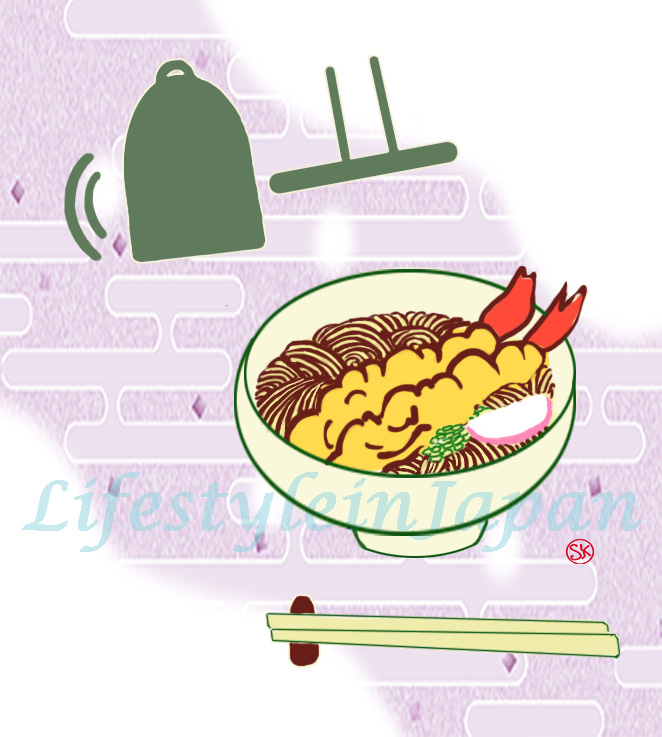
Eating a bowl of toshikoshi soba (年越しそば) with the family to accompany the joya-no-kane, or striking of the temple bells a total of 108 times (to ring away evils of the old year) at midnight on New Year's Eve (大晦日) can be observed in Japan.

Soba (buckwheat noodles) is one of the most favorite food in Japan. The long, thin brownish noodles are made from a mixture of sobako (buckwheat flour) and wheat flour. The ratio of the mixture varies depending on the shop or region, mostly 8:2 or 10. There are two ways of eating soba, hot in broth, or cold in dipped soy-based sauce on a bamboo plate called zaru-soba which you can serve it plain or with variety of toppings, like deep-fried shrimps.

 
Eating toshikoshi soba on the 31 December has been popular in Japan since the mid-18th century or the mid-Edo era. In those days, it is said that eating soba noodles right before New Year symbolize cutting off of bad luck and debts in that the year because it can be easily cut by chopsticks. It also symbolizes longevity and a sustained prosperity for the family since the noodles are long and thin. As buckwheat is a hardy crop, it can survive in cold climates and recover quickly with just little sunlight from wind and rain damages, soba noodles also signify resilience and strength.

There is also another an interesting story that is made popular in the Edo era. It is said that goldsmithsat that time used sobako dumplings to pick up stray pieces of gold dust that had gathered on the tatami mat on the last day of the year. So eating the year-end soba is also associated with wealth accumulation and good fortune.
 
Last but not least, research has found that soba is good for cleansing the blood and lowering blood pressure. So, for a health-conscious Japanese society, eating toshikoshi soba seems to also help to clean the body from the inside to look forward to the coming New Year.

December 12, 2016

10 reasons why Japanese people wear surgical face masks.

1.    When down with a cold or flu
 
Masks were primarily worn by people who had already come down with an illness. If you are feeling sick but can’t take the day off, for the well-being of others, it’s courteous to wear a surgical mask to cover your mouth and nose so as not to spread the infection to your class or office or other commuters. 

2.    For allergy reason
 
According to mass media reports in March 2015,  it is found that 1 in 4 Japanese people are hayfever sufferers. There are different kinds of airborne viruses including the pollen grains that are released from typical seed trees, like cedar () and Japanese cypress(ヒノキ), between February to May, while gramineae pollen grains is (イネ科) at its peak in July and August and ragweed (ブタクサ), between September and October. While there is no conclusive proof that wearing one can actually stop pollen invasion and relieve allergy symptom, many take antihistamines in addition to wearing masks as a basic protection

3.    For protection
 
Commuting in Japan often means spending an hour or more on a crowded train or bus, and not everyone has the space enough to cover their mouth when they cough or sneeze. People just do the right thing to wear a mask than having to breath in someone else’s viruses close by and become sick later. Many people wear masks when they get on domestic airplanes or the Shinkansen too - during the winter and spring seasons.

4.    For anti-social reason

Teenagers wear them, along with audio headsets, to signal a lack of desire to direct communicate with those around them while they are accustomed to communicate indirectly through the social media. Many young women, seeking to avoid harassment from public eyes, also appreciate the relative anonymity the masks provide.

5.    To keep warm

Surgical mask can also be used to keep your nose and cheek warm on a cold winter day. You can safely wear one without attracting any attention outside the hospital. You can even wear one under your ski mask when you go skiing.
 
6.    When not wearing any make-up.

In the Japanese society where attention is always paid to neatness in appearance and attire, wearing masks to hide from the public proved to be handy when one needs to dash out to run errands without bothering with make-up or a touch of the lip-stick.

7.    As part of Fashion

Some people see masks as a fashionable accessory. An online search for this product will bring up hundreds of results, and an increasing number of companies are offering masks in floral, polka dots and lingerie prints, not to mention ninja-style masks for guys.

8.    To Concentrate

Believe it or not I have tried that before. A number of people said that a mask helps them focus on study or work. People wearing masks can be seen in public libraries, not to mention, some sleeping comfortably on their chairs wearing one.

9.    Jobs that require wearing masks

Masks are a must for singers as it keeps her or his throat moist before a live concert. Street contractors or factory workers wear masks to protect themselves against dust and pollution. Celebrities who don't want to be noticed in public with no makeup, wear masks when they travel.

10.   Calls from government agencies
 
When it comes to preventing massive influenza and viruses outbreak, especially in seasonal winter, masks become widely recommended. Health agencies would urge mask use, along with frequent hand-washing. Many schools too ask students to come to school with masks and advise them to refrain from touching their noses with hands and fingers.

December 2, 2016

Chushingura: A Story behind “Bushido”, the Soul of Japan

Every year from November to December, a familiar historical story is told in kabuki repertoires, bunraku plays, movies, TV drama and even novels, entitled Chushingura (忠臣蔵, The Treasury of Loyal & Dutiful Retainers). This tragic and touching story is related to an incident that involves forty-seven ronins (leaderless samurai warriors) and their mission to avenge the death of their lord master in the Edo era  

Artwork of Utagawa Hiroshige
Called the “Ako Incident” (赤穂事件), this true historical event occurred at the Pine Corridor of Edo Castle in 1701 when there was a tension over matters of protocol between two daimyo lords, Asano Naganori, the lord of Ako and Kira Yoshinaka, a court master. It is said that the corrupted Kira insulted Asano into drawing his sword and attempting to kill him. Asano was immediately sentenced to commit seppuku, the ritual suicide by the shogunate authorities, his lands were confiscated and house was abolished while Kira was left unpunished. Asano’s retainers were angry and vowed to take revenge for their lord but this proved to be an arduous task. After almost two years of careful and secret planning, they finally killed Kira and went to the grave of their lord to convey this. They then surrendered themselves to the authorities and were ordered to commit seppuku. Seppuku is an honorable death which is unlikely for committing any murder but somehow they could for their loyalty and conduct and now the forty-seven ronins lie peacefully besides their master at Sengakuji Temple, Takanawa, Tokyo 

The Ako incident remains as a legend. Ako city in Hyogo Prefecture, the ancient ruling base of Asano and his retainers, holds the Ako Gishisai festival (赤穂義士祭)on December 14 every year to commemorate this event. http://www.city.ako.lg.jp/

“Bushido” (武士道) has long been referred to for hints and insights into the character of the Japanese people. “Bushido” symbolizes the ethical code of samurai warriors that is based on a moral way of life and can be traced back to Chūshingura. This “way” stressed on loyalty, courage and honor until death.

Chūshingura, been one of the most popular themes of all literature and historical stories in Japan, often strikes a chord with many Japanese people, even now, because it symbolizes bushido that commonly embraced an emblematic virtues of dedication, benevolence, courage, respect, politeness, sincerity, honor, loyalty and self-control in which all good people would persevere in their daily lives.

November 29, 2016

Art Masters Who Inspire (1): Ito Jakuchū (伊藤若冲)

My first art master to write about is Ito Jakuchū(1716-1800). His work is a source of inspiration for many artists in Japan, including myself for his meticulously detailed and vivid-colored paintings.

Ito Jakuchū is well-known for his 30-scroll series of classical paintings called “Colorful Realm of Living Beings”(動植綵絵, doushoku-saie) created over a span of some 10 years (1757-1766). These scroll paintings on silk are one of Japan's most renowned cultural treasures, present a range of natural world subjects- chickens, butterflies, insects, flowers, birds and plants.


⏪ (In the" Roosters" (群鶏図, Gunkei-zu), Jakuchū painted different shades of lights and layers making the roosters in their surrounding taking on a life)

Notably, Jakuchū's popularity has soared in recent years in Japan, a powerful “Jakuchū boom”, with wide media coverage and a long waiting queue to more than 2 hours at exhibition halls. More than 14,000 visitors per day come to see his extraordinary works

A study of the pigmentation has found that he layered one color on top of another after each drying and added a sub-layer of color on the back of the silk to give it a spatial depth. He also experimented with mineral and vegetal pigments to achieve different grades of opacity and transparency. His innovative and experimental style was influenced by direct observation of nature and patterns and designs of Kyoto textiles while study Zen Buddhism and Chinese painting in 1755.

The “Colorful Realm” is now with the Museum of the Imperial Collection, Tokyo.  They were first donated to Shoukokuji, a major Zen monastery in Kyoto. Another of his famous 3-set hanging scrolls, “ Sayamuni Triptych" (釈迦三尊図 ) is exhibited at Shoukokuji. You may recognize this famous piece of art “Birds and Animals in the Flower Garden” (鳥獣花木図屏風, Choujuukaboku-zu byoubu) from the Price Collection in Los Angeles along with several other collections that had crossed Pacific Ocean.
 
 It depicts a white elephant and a number of other animals in a garden. But a closer look shows the precision work on each grid of 1 cm square shape he had created in the pair of six-folded screen.
 
Year 2016 celebrates the 300th anniversary of his birth. If you have a chance to be in either Tokyo or Kyoto, be sure to look out for an exhibition work of his paintings worth an awesome visit.
 

November 14, 2016

Why are Japanese toilets so high-tech?

As we use the lavatory several times a day, a great deal of attention is given to technologies that make toilets clean. To the Japanese, to be “cleaned” means “hygienically cleaned”, that is, guarding oneself against infection or disease, and this must first come from keeping the hands and lavatory “clean”.

The age of high-tech toilets in Japan started in 1980. Since then, the country has been replacing regular flush toilets with modern style washlets, providing users a wide variety of functions like bidet heated seats, nozzles (warm water jets) and flushing at the touch of a button, and even some seats and lids can be raised and lowered automatically. Recent years have seen the appearance of antibacterial toilet seats and toilets that consume very little water, not to mention, eco-friendly customized toilets catering to the needs the graying society and the blinds.

In the crowded living conditions of Japanese cities, the toilet is one of the few rooms in the house that allows for privacy. As most houses lack central heating, the little space heating on the toilet seat can be quite comfortable and enjoyable to sit on. Some toilet rooms are filled with character goods, pictures and fans’ posters, others are equipped with shelves for books or newspaper reading.

The toilet is not only a place to relief yourself. With technologies, toilets not only make our lives more comfortable but play an important role in maintaining personal and conserving environmental health.

November 7, 2016

Shichi-Go-San (七五三)

Shichi-Go-San is a celebration for children from late October to mid-November. It is said to have originated in the Heian period amongst court nobles who would celebrate the passage of their children into middle childhood. Shichi-go-san literally means “seven, five three”, the age of children who are blessed on this day.  It is believed that children are given the gift of language at the age of three, intelligence at five, and teeth at seven. The 15th of the month was chosen for the celebration in the old days because the sum of the three numbers, 15 is regarded as having strong power to repel evil spirits. It’s not difficult to imagine parents’ joy at celebrating the growth of their kids when children’s mortality rate was high.

During the 18th century, children, up to age of three, who were required by custom to have shaved head were allowed to grow their hair. Boys of age five could wear hakama (袴)for the first time, while girls of age seven replaced the hifu (被布ーvest cover) and simple cords they used to tie their kimono at age three with the traditional obi, a shigoki (しごき帯) cloth covering part of the obi tied with a ribbon knot behind and a hakoseko(箱せこ)purse tugged under her chest. This is a day for children to get a sense of their own growth.

Chitose Ame (千歳飴) literally means “thousand year candy” is given to children on this day. It is a long, thin, red and white candy, which symbolizes healthy, growth and longevity. It is given in a bag decorated with a crane and turtle which represent long life

The tradition hasn't changed much since the Meiji period. While the ritual regarding hair has been discarded, these days, modern ritual of dressing up in kimonos, visiting a shrine, photo-taking session and family dining are still common practices.