Showing posts with label Customs & Tradition. Show all posts

July 2, 2017

Tanabata (七夕), Wishing upon a Star


Tanabata, also known as the "star festival", takes place on the 7th day of the 7th month of the year, when, according to a Chinese legend, the two stars Altair and Vega, which are usually separated from each other by the milky-way, are able to meet.

Altair is said to breed cattle while Vega weaved cloths in the heaven. On this special day, a popular custom is to offer livestock miniatures made of the early summer vegetables in the season such as putting short-cut chopsticks into the body of eggplant, cucumber, and corn to compare them to the legs of cattle and horse miniatures and put the miniatures under the bamboo tree.
 
 
Another popular Tanabata custom is to write one's wishes on a piece of paper, and hang that piece of paper on a specially erected bamboo branch, in the hope that the wishes become true. As Tanabata approaches, decorated bamboo branches can be seen all around the neighborhood, signaling that summer has finally arrived and that summer vacation is just around the corner.

Delicacies of the summer, such as chilled watermelon, somen (fine noodles usually eaten cold), edamame (young soya beans in the pod), azuki bean jelly and pickles are also eaten to welcome the season.

 七夕さま, The Tanabata Song

ささのは さらさら      The bamboo leaves rustle
のきばに ゆれる
           shaking away in the leaves
お星さま きらきら
      The stars twinkle
きんぎん すなご
          on the gold and silver grains of sand
ごしきの たんざく
      The five-colored mulberry paper strips
わたしが かいた
          I have already written
お星さま きらきら
      The stars twinkle,
空から  見てる          they watch us from heaven.

June 8, 2017

Mt Fuji, a Symbol of Japan


"South Wind, Clear Sky" Katsushika Hokusai

Mt Fuji,  a source of artistic inspiration, and an object of worship, resides deep within every Japanese people. That’s why the sacred mountain is deserved to be designated as a World Cultural Heritage site.

Since ancient times, Japanese people have regarded Mt Fuji as a symbol of national spirit and a source of inspiration. The breathtakingly beautiful mountain was featured prominently in literature and artwork such as wood blocks painting, Ukiyo-e, that has influenced many European artists, like Vincent Van Gogh. Renowned for its symmetry and serenity, it is photographed for its marveling scenery-snow-covered tranquility in winter and vitality and energy in summer.  

Mt Fuji has also been an object of religious worship as Japanese people traditionally regarded that divinity resides in all aspects of the nature. In the past, Mt. Fuji erupted many times and was feared by the people living around it. They believed in the Great God, Asama who resided at the top of the mountain, had the ability to keep Mt. Fuji calm and so Mt. Fuji's peak was considered sacred. After Mt. Fuji entered into a period of no eruptions, this faith changed into a form of mountain climbing activities. From the beginning of the 20th century that eventually developed into a new religion called Fuji-ko, a group of pilgrims climbing Mt Fuji for religious beliefs. The popularity of the pilgrimage reached its peak in the latter half of Edo period which spread mainly amongst commoners. The result, now, a drastic increase in the number of people who come to climb Mt. Fuji.

July 1st is the traditional opening day for climbers because perilous snow remains above the fifth level, until the end of June and climbing season comes to a close end of August because summer on Mt. Fuji is rather short. Located between Yamanashi and Shizuoka, Mt. Fuji is the main attraction of the Fuji-Hakone-Izu National Park. There are also museums, shops and hot springs to visit and many fun activities, such as fishing and marine sports. There are also many hotels and summer villas lining the waters of the lake and the natural beauty of the surrounding area will guarantee an enriching experience.

June 3, 2017

The Japanese Tea Ceremony: Cha-no-yu


The act of preparation and drinking of matcha, the powdered green tea known as “The Japanese Tea Ceremony”, is referred to as ‘Cha-no-yu”, (茶の湯) by Japanese people, literally means “Hot water for tea”. The procedure involves much more than its name implies. Better translated as Sado (茶道), ”the way of tea”, it is a way of life or a life style in devotion to preparing the best possible bowl of powdered green tea for the guests, Sado is a choreographed art and spiritual discipline requiring many years of study to master. (This “way of life style” also applies to disciplines, like, Budo (武道)-martial art, Kado (華道)-flower arrangement and Shodo (書道)-calligraphy as well).

As an art, the tea ceremony is an occasion to appreciate the simplicity of the tea room’s design, the tranquility of the garden, the feel of the chawan or tea bowl in the hand, the company of friends, and simply a moment of purity. As a discipline, aesthetic contemplation of flower arranging, ceramics, calligraphy, is required. The ritual preparation requires the host or Teishu to know how to arrange the flowers which will be placed in the alcove or Tokonoma, how to cook a Kaiseki meal in a special occasion, When choosing tea utensils, the host has to consider the rank and type to make sure that they will stand out. Even when placing the tea utensils, the host has to considered the guests’ view point, gestures and movement

Tea is said to have been brought to Japan from China during the Nara period. It was gradually accepted after the Zen master Eisai wrote the book “Kissa Yojo-ki” (喫茶養生記, Cure on Drinking Tea for Health) during the Kamakura era, stressing the effectiveness of tea as medicine. The act of drinking tea became a special experience during the Muromachi period, during which the shoin design was developed, which evolved as the tea houses that we see today. Procedures for making tea called Temae for tea ceremony were established, with deep roots to the philosophy of Zen,

The culture and spirit of the Tea Ceremony: Sen Rikyu, Wabi-sabi and Ichi-go-ichie

Sen Rikyu was a tea master during the Azuchi-Momoyama era in the 1500s. He served two Shoguns, Oda Nobunaga and Toyotomi Hideyoshi, a time when tea ceremony had been popular among warriors as a symbol of refined culture. A tea master needs to be able to properly determine the utensils for tea ceremony. With his discerning eye, Rikyu stood out among the tea masters. Rikyu surprised those around him by introducing innovative ideas for tea ceremony such as the  four-and-a-half mats koma or dark, tiny tea room where the ceilings were too low to stand upright, and the use of black raku-ware tea bowls he had made by Japanese craftsmen to use in place of Chinese imports for use in the wabi-style tea ceremony.

Wabi-sabi refers to a quiet, serene world in its simplicity. In its root form, wabi includes “the pain of not having things proceed as desired”, and sabi means “the state of the power of life deteriorating”, both negative expressions of condition. Inversely, it is possible to see a uniquely Japanese sense of beauty and culture from the use of these terms as “appreciating the beauty of things that are simple and natural,” and that began after the Edo period as “positive terms for expressing the beauty of Japan. “The tea room’s interior will seem imperfect and rustic. The wall might be unpainted and visible wooden pillars and beams are untreated, just as it would look like in nature”.

Ichi-go-ichie: “One opportunity, one encounter”, meaning that every encounter should be cherished as it may never happen again. Today, remains a symbol of the spirit of tea ceremony, the term Ichi-go-ichie was mentioned by Yamanoue Soji, an apprentice of Sen Rikyu as, “This tea ceremony, held on this day of this year, is an irreplaceable moment that will never again be repeated. Tea ceremony can only be a success when the minds of both the person serving and those being served come together as one”. Ichi-go-ichie applies not only to tea ceremony but other situations as well, where every moment is unique, and will never come again

May 2, 2017

The Carps Streamers, Koinobori


Koinobori, (鯉のぼり) carp streamers or carp banners, decorate the landscape of Japan from April through early May, in celebration of Tango no Sekku (端午の節句), a calendrical event which is now designated a national holiday, Children's Day (子供の日) on May 5.

Also known as the Boys' Festival traditionally, it is an event expressing hope that each boy in the family will grow up healthy and strong like carps. Carp symbolizes courage and strength because of its ability to swim up a waterfall. During this festival, families with boys, like the doll festivals for girls, set up a warrior doll or a yoroi armor set in the house and raise the Koinobori outside the house, allowing it to flutter in the wind

Originally, the banners were used by samurai warriors on the battlefield. Whenever the warriors were on the battlefield, they wore full yoroi armor and flew banners. The banners were painted in various colors and shapes. Some of them had carp pictures on them. Then they became carp banners at the beginning of the modern age.

A typical koinobori set consists of, from the top of the pole down, a pair of arrow-spoked wheels (yaguruma) with a ball-shaped spinning vane followed by streamers (fukinagashi) down the pole that look like windsocks, with a black koinobori and a red koinobori representing the father and mother. If more children are in the household, an additional blue, green and then purple or orange koinobori are added. Traditionally, the set would contain a black koinobori representing the father, followed by a smaller, red koinobori representing his eldest son. (This is why the mother is not present in the children’s song, See below.) After the government's decree that converted Boy's Day into the present Children's Day, the holiday came to celebrate the happiness of both boys and girls.


Japanese iris bloom in spring and are especially associated with the month of May for Children’s Day. An alternate name for Japanese iris is shōbu (菖蒲 ) which is a homophone for martial spirit (尚武 ). During the Edo period Edo, it was celebrated with mock duels between boys using shōbu in place of swords. In some families, boys take iris-power water bath in the hope that they would grow up healthy and strong enough to survive through the summer heat.

Today, along with the raising of Koinobori carp streamers, children also eat kashiwa-mochi, sticky rice cakes wrapped in oak leaves, and other sweets and thank and show respect for relatives, parents, and teachers for support throughout their life.
 
Children’s Song, Koinobori, (鯉のぼりの歌)
 
やねより たかい こいのぼり        Higher than the roof-tops are the carp-streamers
おおきい まごいは おとうさん      The large carp is the father
ちいさい ひごいは こどもたち      The smaller carp are the children
おもしろそうに およいでる            They seem to be having fun swimming.


March 2, 2017

Hina Matsuri, Girl’s Day on March 3

March 3 is Hina Matsuri (Doll or Girls’ Festival) when people pray for the happiness and healthy growth of girls. Families with young daughters mark this day by setting up a display of dolls inside the house and offer Hina-arare rice crackers and other food to the dolls.

Traditionally, this day is called Joushi (上巳) or Momo no Sekku (Girl’s Day), one of the five days in the year, each announces the change of the season in the traditional Japanese calendar. It is said that Joushi was first celebrated by courtiers during the Heian period (794-1192). On the third of the lunar month, courtiers floated rice wine down a stream in the palace garden. Each guest would take a sip and then write a poem called Waka (和歌). At some point, paper dolls were introduced and this gradually began to be celebrated as Girl’s Day. In some rural parts of the country, people would release paper dolls into rivers after the festival to be washed away, praying that the dolls would take people's place in carrying away sickness and bad luck and pray for health and prosperity. The event is also celebrated with bowls of claim broth. Claims are thought to be a symbol of luck in marriage for girls, as one half of a claim shell will only match perfectly with its other half, and no other half.

Display of dolls in a five-tier decoration platform
While it’s rare to see several tiered platform display like the picture above in a small crammed apartment in big cities, it’s more common to see a single-tiered decorations with one male and one female doll that to do not take up much space and at the same time parents are able to celebrate this occasion with their daughters.

Nevertheless in a traditional house, different dolls wear costumes of the imperial court during the Heian period and are placed on a tiered platform covered with red felt. The size of the dolls and number of steps vary, but usually the displays are of five or seven layers.
The top tier is reserved for the emperor and the empress. A miniature gilded folding screen is placed behind them. On the second tier are three ladies-in-waiting, and on the third are five male court musicians. Ministers sit on either side of trays of food on the fourth step, and the fifth row features guards flanked by an orange tree to the left and a cherry tree to the right.
 
These days, most families take their beautiful collection of dolls out of the closet around mid-February and put it away again as soon as Hinamatsuri is over. This is because of an old superstition that families that are slow in putting back the dolls have trouble marrying off their daughters.

Children's Song  うれしいひな祭り(Happy Hina Matsuri)

あかりをつけましょ ぼんぼりに          Let's light up the paper-shade lamps
お花をあげましょ 桃の花                    Let's wreathe the platform with peach flowers

五人ばやしの 笛太鼓                         And, enjoy flutes and drums of the five court musicians           
今日はたのしい ひなまつり                For today we celebrate the doll festival

お内裏様(だいりさま)と おひな様       See the emperor and the empress
二人ならんで すまし顔                        Sit side by side still and composed
お嫁にいらした 姉様に                        And, see snow-white faced court lady 

よく似た官女の 白い顔                        Reminds me of my sister when she was a bride                    

金のびょうぶに うつる灯(ひ)を           Dim lght reflected on the golden folding screen    
かすかにゆする 春の風                      With spring breeze swaying feebly felt
すこし白酒 めされたか                        Did he take a sip of the sake from the altar?
あかいお顔の 右大臣                          The bearded reddish face of that minister

着物をきかえて 帯しめて                    Change in your kimono and fasten your obi belt
今日はわたしも はれ姿                       For today we make our formal appearance
春のやよいの このよき日                    Warm spring bless this good day
なによりうれしい ひなまつり                There is nothing more wonderful than the doll festival


February 2, 2017

Mamemaki: Demons Out! Luck in!


Setsubun (節分) celebrated yearly on February 3 in Japan is accompanied by a special custom called mamemaki (豆まき), literally means “bean scattering”. This is to drive away evils who bring misfortune and bad health for the coming year and welcome fortune into the household.  Setsubun, "division of seasons", used to mark the end of winter and summer, means the day before the first day of spring (立春risshun)

Roasted soybeans called the "fortune beans" (福豆fukumame,) are thrown either out the window or at a member of the family wearing an oni or an ogre mask, while the people shout  "Demons out! Luck in!" (鬼は外! 福は内!, Oni wa soto! Fuku wa uchi!?) and then eat the soybeans, one for each year of one’s life to bring good luck and prevent sickness for the year to come. While this is still a common practice in households, many people also attend a shrine or temple's spring festival where this is done.

In popular temples like Senso-ji in Asakusa, Tokyo or the Naritasan Shinshou-ji, Chiba, where they receive wide media coverage, celebrities, sumo wrestlers or kabuki actors are invited and they throw roasted soy beans, small envelopes with money, sweets, candies and other prizes. Crowds of nearly 100,000 people who attend the annual festival turn wild with everyone pushing and shoving to get the gifts tossed from above.

Another practice like in the Kansai area or Osaka, it is customary for families to eat uncut makizushi called eho-maki (恵方巻, lucky direction roll) while facing the direction considered to be auspicious usually determined by the zodizc symbol of that year. Eho-maki can also be purchased at stores in the Kanto area and it is getting more recognized as a part of Setsubun tradition. In some families living near the coastal area, it's common to put up small decorations of sardine and holly leaves (柊鰯 hiragi iwashi) on their house entrances so that bad spirits will not enter. Other practice such as in more remote areas would include religious dance, festival and bringing tools inside the house that might normally be left outside to prevent the spirits from harming them.
 
Children's Song: 豆まき (Mamemaki)

おにはそと  ふくはうち              Demon Out! Luck In!
ぱらっ ぱらっ ぱらっ ぱらっ   Parat Parat Parat Parat
まめのおと                                 Sound of bean scattering
おには こっそり  にげていく     Demon slips away quietly

おにはそと  ふくはうち               Demon out! Luck in!
ぱらっ ぱらっ ぱらっ ぱらっ    Parat Parat Parat Parat
まめのおと                                  Sound of bean scattering
はやく おはいり  ふくのかみ    Happy Luck, Quick! Come in

January 1, 2017

O-Zoni (お雑煮): Japanese Mochi Soup for the New Year’s Day

Zoni (雑煮), often with the honorific "o-" as o-zoni, is a Japanese soup containing mochi rice cakes, fish and vegetables. The soup is considered the most auspicious dish to be eaten on New Year’s Day.

Zoni prepared by households varies depending on the regions in terms of the mochi used, stock soup and ingredients.
 
In the Kanto and Tohoku region, for instance, the mochi are cut into squares and grilled before being added to the stock. In the Kansai and the Chugoku region, a round, boiled mochi is generally preferred while in most of the Kyushu region, a round mochi is popular, but grilled or boiled difference changes depending on area.

In terms of soup stock, in the Kanto region, zoni consists of a clear soup called sumashi-jiru which is flavored with dashi, a stock made from flakes of dried bonito, kombu and soy sauce. In the Kansai region and eastern Shikoku, zoni is made with a stock of white miso, while in parts of Fukui Prefecture, zoni is made with a stock of red miso.

The ingredients added to the soup depend on local specialty-what is readily available in that region. Below is a picture of some of the different zoni-s and ingredients prepared by different regions.


  But whatever the style is, considering that the first day of the month had been called Tsukitachi (rising of the moon), eating zoni on the morning after that means that the body is prepared to accept new things.


December 29, 2016

Year-End Soba to End the Year and Welcome a New Year

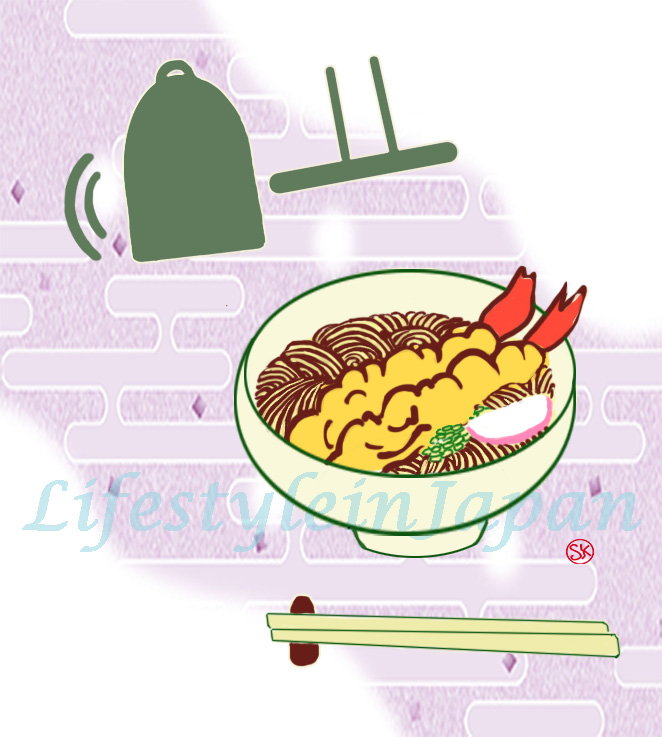
Eating a bowl of toshikoshi soba (年越しそば) with the family to accompany the joya-no-kane, or striking of the temple bells a total of 108 times (to ring away evils of the old year) at midnight on New Year's Eve (大晦日) can be observed in Japan.

Soba (buckwheat noodles) is one of the most favorite food in Japan. The long, thin brownish noodles are made from a mixture of sobako (buckwheat flour) and wheat flour. The ratio of the mixture varies depending on the shop or region, mostly 8:2 or 10. There are two ways of eating soba, hot in broth, or cold in dipped soy-based sauce on a bamboo plate called zaru-soba which you can serve it plain or with variety of toppings, like deep-fried shrimps.

 
Eating toshikoshi soba on the 31 December has been popular in Japan since the mid-18th century or the mid-Edo era. In those days, it is said that eating soba noodles right before New Year symbolize cutting off of bad luck and debts in that the year because it can be easily cut by chopsticks. It also symbolizes longevity and a sustained prosperity for the family since the noodles are long and thin. As buckwheat is a hardy crop, it can survive in cold climates and recover quickly with just little sunlight from wind and rain damages, soba noodles also signify resilience and strength.

There is also another an interesting story that is made popular in the Edo era. It is said that goldsmithsat that time used sobako dumplings to pick up stray pieces of gold dust that had gathered on the tatami mat on the last day of the year. So eating the year-end soba is also associated with wealth accumulation and good fortune.
 
Last but not least, research has found that soba is good for cleansing the blood and lowering blood pressure. So, for a health-conscious Japanese society, eating toshikoshi soba seems to also help to clean the body from the inside to look forward to the coming New Year.

December 2, 2016

Chushingura: A Story behind “Bushido”, the Soul of Japan

Every year from November to December, a familiar historical story is told in kabuki repertoires, bunraku plays, movies, TV drama and even novels, entitled Chushingura (忠臣蔵, The Treasury of Loyal & Dutiful Retainers). This tragic and touching story is related to an incident that involves forty-seven ronins (leaderless samurai warriors) and their mission to avenge the death of their lord master in the Edo era.   

Artwork of Utagawa Hiroshige
Called the “Ako Incident” (赤穂事件), this true historical event occurred at the Pine Corridor of Edo Castle in 1701 when there was a tension over matters of protocol between two daimyo lords, Asano Naganori, the lord of Ako and Kira Yoshinaka, a court master. It is said that the corrupted Kira insulted Asano into drawing his sword and attempting to kill him. Asano was immediately sentenced to commit seppuku, the ritual suicide by the shogunate authorities, his lands were confiscated and house was abolished while Kira was left unpunished. Asano’s retainers were angry and vowed to take revenge for their lord but this proved to be an arduous task. After almost two years of careful and secret planning, they finally killed Kira and went to the grave of their lord to convey this. They then surrendered themselves to the authorities and were ordered to commit seppuku. Seppuku is an honorable death which is unlikely for committing any murder but somehow they could for their loyalty and conduct and now the forty-seven ronins lie peacefully besides their master at Sengakuji Temple, Takanawa, Tokyo 

The Ako incident remains as a legend. Ako city in Hyogo Prefecture, the ancient ruling base of Asano and his retainers, holds the Ako Gishisai festival (赤穂義士祭)on December 14 every year to commemorate this event. http://www.city.ako.lg.jp/

“Bushido” (武士道) has long been referred to for hints and insights into the character of the Japanese people. “Bushido” symbolizes the ethical code of samurai warriors that is based on a moral way of life and can be traced back to Chūshingura. This “way” stressed on loyalty, courage and honor until death.

Chūshingura, been one of the most popular themes of all literature and historical stories in Japan, often strikes a chord with many Japanese people, even now, because it symbolizes bushido that commonly embraced an emblematic virtues of dedication, benevolence, courage, respect, politeness, sincerity, honor, loyalty and self-control in which all good people would persevere in their daily lives.

November 7, 2016

Shichi-Go-San (七五三)

Shichi-Go-San is a celebration for children from late October to mid-November. It is said to have originated in the Heian period amongst court nobles who would celebrate the passage of their children into middle childhood. Shichi-go-san literally means “seven, five three”, the age of children who are blessed on this day.  It is believed that children are given the gift of language at the age of three, intelligence at five, and teeth at seven. The 15th of the month was chosen for the celebration in the old days because the sum of the three numbers, 15 is regarded as having strong power to repel evil spirits. It’s not difficult to imagine parents’ joy at celebrating the growth of their kids when children’s mortality rate was high.

During the 18th century, children, up to age of three, who were required by custom to have shaved head were allowed to grow their hair. Boys of age five could wear hakama (袴)for the first time, while girls of age seven replaced the hifu (被布ーvest cover) and simple cords they used to tie their kimono at age three with the traditional obi, a shigoki (しごき帯) cloth covering part of the obi tied with a ribbon knot behind and a hakoseko(箱せこ)purse tugged under her chest. This is a day for children to get a sense of their own growth.

Chitose Ame (千歳飴) literally means “thousand year candy” is given to children on this day. It is a long, thin, red and white candy, which symbolizes healthy, growth and longevity. It is given in a bag decorated with a crane and turtle which represent long life

The tradition hasn't changed much since the Meiji period. While the ritual regarding hair has been discarded, these days, modern ritual of dressing up in kimonos, visiting a shrine, photo-taking session and family dining are still common practices.